
Reviewed · DANISH CASTLES AND PALACES
Grand Tour of Copenhagen – The Little Mermaid to Royal Castle
See Copenhagen before lunch. This guided city tour links the Little Mermaid, royal palaces, old canals, Christianshavn, and Nyhavn in one tidy outing, making it a smart first look at the Danish capital. I like the wide range of sights and the helpful guide service, especially for visitors with only a few hours before a cruise. The main drawback is that two and a half hours leaves little time for interior visits or long stops.
The tour costs $61.40 per person and usually sells about 46 days ahead. That price feels fair if you want transportation, commentary, Wi-Fi, and a quick orientation rather than a slow museum day. You should expect a sightseeing circuit with photo stops, short walks, and plenty of history delivered from the road.
In This Review
- Key points at a glance
- Why this short Copenhagen tour works
- Starting at Tivoli and the city center
- Rosenborg Castle and royal Copenhagen
- Resistance stories and the Gefion Fountain
- The noon guard change at Amalienborg
- Marble Church and the route to Christiansborg
- Thorvaldsen, the Royal Theatre, and the harbor
- Børsen, Christianshavn, and the Black Diamond
- Langebro and Nyhavn’s colorful finish
- What $61.40 buys you
- Guide quality and the right kind of guest
- Should you book this Copenhagen tour?
- FAQ
- How long does the Grand Tour of Copenhagen last?
- What time does the tour begin?
- Where does the tour start?
- Where does the tour end?
- Is pickup available?
- Is lunch included?
- What is included in the price?
- How many people can join the tour?
Key points at a glance
- See the Little Mermaid and Gefion Fountain together, two waterfront symbols that are easy to miss when you are exploring on your own.
- Watch the noon guard change at Amalienborg, with about 20 minutes set aside around the royal square.
- Cover Copenhagen’s major districts quickly, including Christianshavn, Nyhavn, the old center, and the harbor.
- Use the tour as a cruise-day transfer, since pickup is offered and past bookings have included hotel-to-cruise-port arrangements.
- Ride in an air-conditioned vehicle with Wi-Fi and an audio guide, useful when the weather turns cool, wet, or windy.
- Expect a small-to-medium group of no more than 33 people, not a private tour but far less unwieldy than a large coach outing.
Why this short Copenhagen tour works
Copenhagen rewards walking, but its headline sights are spread across several areas. The Little Mermaid sits by the northern harbor, Amalienborg occupies the royal quarter, Christiansborg anchors the old center, and Nyhavn lies farther east along the water. Covering all of that on foot in one morning would mean a rushed march.
This tour solves that problem with an air-conditioned vehicle, a host or driver, Wi-Fi, and an audio guide. The vehicle gives you a useful overview before you decide where to spend more time later. You can see the city’s royal, maritime, political, and cultural sides without spending the whole day navigating buses and streets.
I especially like the mix of famous sights and less obvious details. You get the postcard stop at Nyhavn, but also the old Stock Exchange, Holmens Church, the Black Diamond library, Langebro, and the canals of Christianshavn. That gives the outing more substance than a simple parade of photo stops.
The format is not designed for museum lovers who want to study one collection at length. The Danish Resistance Museum, Thorvaldsen Museum, National Gallery, and other cultural sights appear as part of the route, but the supplied timing does not promise admission or extended visits. Think of them as landmarks to note for a later visit.
More castles and palaces in Copenhagen:
- Copenhagen: Kronborg, Frederiksborg Castle and Roskilde Tour
★ 4.9 · 1,763 reviews - Copenhagen: Rosenborg Castle Entry Ticket
★ 4.6 · 381 reviews - Full-Day; Castle, Palace, Cathedral & Viking ships Tour
★ 5.0 · 326 reviews
Starting at Tivoli and the city center
The morning begins at 9:30 am from Banegårdspladsen 2, beside Copenhagen’s central railway area. The listed route includes Tivoli Gardens, the beloved amusement park opened in 1843 by Georg Carstensen. Even if you only see it from outside, its location helps place you right in the center of Copenhagen’s sightseeing zone.
Tivoli is not simply a collection of rides. It has long been part of the city’s cultural life, and its age helps explain why Copenhagen feels comfortable mixing old civic buildings with modern public spaces. On this tour, though, you should not expect time to enter and explore the gardens.
The route also passes the art museum with ancient Mediterranean sculptures and French and Danish works from the 19th century. This appears to refer to the Ny Carlsberg Glyptotek, though the provided description does not name it directly. The important point for you is that Copenhagen’s art scene enters the tour early, even though an admission visit is not listed.
The city’s botanical collection is another early highlight. The State Natural History Museum’s plant collection covers 10 hectares and includes the Palm House. The route also points out Athena and Marsyas by Myron and the old Østervold Observatory, linked with astronomer Tycho Brahe.
These stops show how much the tour tries to pack into a morning. You may hear a short explanation and see the setting from the vehicle rather than step inside. That is useful for orientation, but you will need another visit if you want the Palm House, museum galleries, or observatory in detail.
Rosenborg Castle and royal Copenhagen
Rosenborg Castle is one of the most appealing exterior views on the route. King Christian IV built it in Dutch Renaissance style, and its outside appearance remains much as it was when first constructed. The castle’s scale is more intimate than the grand royal buildings later in the tour, which makes it an easy sight to appreciate during a short stop.
You can use this point to understand Copenhagen’s royal story. Rosenborg recalls the city’s earlier kings and palace building, while Amalienborg represents the modern royal household. Christiansborg adds parliament and state ceremony to the picture.
The Little Mermaid follows as the tour’s first named stop. She has sat on her granite rock since 1913, a gift from Carl Jacobsen, founder of the Carlsberg Brewery. Edvard Eriksen sculpted her in bronze, drawing on Hans Christian Andersen’s story of a mermaid who falls in love with a human prince who does not return her love.
The sculpture is smaller than many first-time visitors expect. That is part of the practical lesson here: go for the setting, the story, and the place she holds in Copenhagen’s identity, not for monumental size. The rock is accessible at low tide, although the tour does not promise that you will walk onto it.
Her turbulent public life gives the stop an extra story. The statue has been beheaded twice, lost an arm once, and been splashed with red paint. Political words have also appeared on her. You may spend only about five minutes here, so have your camera ready and listen closely.
Resistance stories and the Gefion Fountain
The Danish Resistance Museum sits underground in a newer building opened in 2020. Its earlier building burned in 2013, while most of the collection survived. The museum tells how daily life changed during the German occupation from 1940 to 1945, with special attention to Danish resistance groups.
This is an important sight to mark for a longer visit. The subject is serious, and a quick exterior explanation cannot replace the exhibits. Still, including it in the route reminds you that Copenhagen’s story is not limited to palaces, canals, and colorful houses.
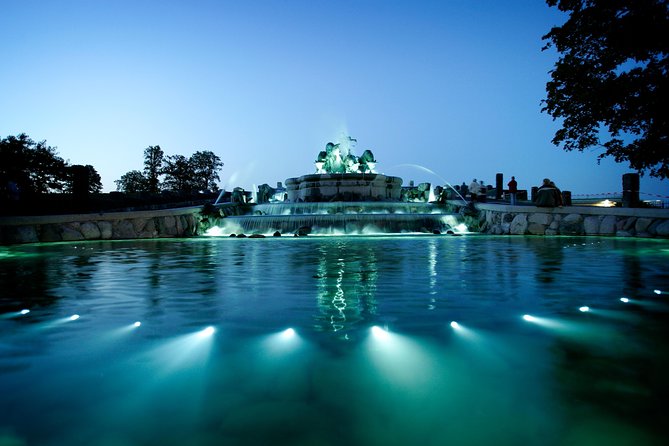
Nearby, the Gefion Fountain gives the waterfront a more theatrical mood. It honors the goddess Gefion, who turned her sons into oxen and used them to plow the island of Sjælland from Swedish soil. The Carlsberg Foundation paid for the fountain, and sculptor Anders Bundgaard worked on it between 1897 and 1899. The basin was finished in 1908, when the fountain first operated.
The fountain pairs naturally with the Little Mermaid. Both are close to the water, both connect Copenhagen with well-known Danish stories, and both make quick but worthwhile photographs. You get more from the stop if you pay attention to the figures and movement in the sculpture rather than treating it as another hurried snapshot.
A completely different kind of day out:
- Copenhagen: Canal Cruise with Guide
★ 4.6 · 9,115 reviews - Copenhagen: Hop-On Hop-Off Bus Tour with Boat Tour Option
★ 3.9 · 4,122 reviews - Private Walking Grand Tour of Copenhagen
★ 5.0 · 3,953 reviews - From Copenhagen: Lund and Malmö 2-Country Tour
★ 4.7 · 2,772 reviews
The noon guard change at Amalienborg
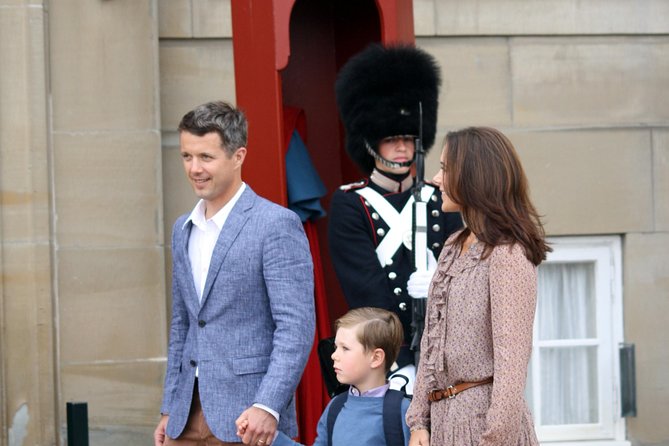
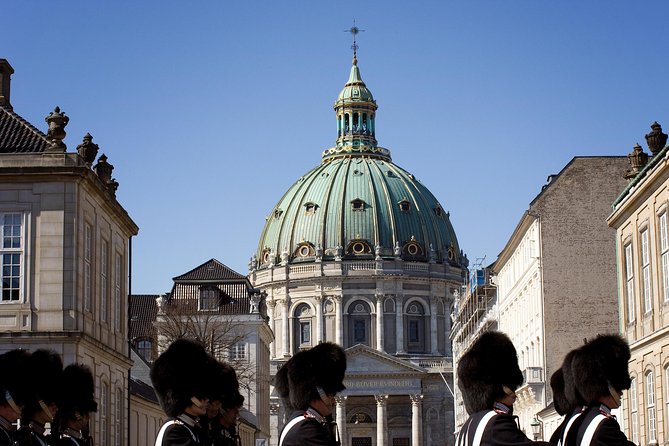
The tour’s most time-sensitive moment is the changing of the guard at Amalienborg Castle. The Life Guards take part in the ceremony every day at midday, and the schedule allows about 20 minutes with no admission charge.
Amalienborg consists of four palaces: Christian VII’s, Christian VIII’s, Frederik VIII’s, and Christian IX’s. The royal family moved here in 1794 after Christiansborg Castle burned. Frederik VIII’s Palace is used by King Frederik X and Queen Mary when they are in Copenhagen.
This stop gives you a clear reason to choose the 9:30 departure. The tour is planned to reach the royal square around noon, so you are not just looking at palace facades. You may see the guards move through the square and get a sense of how the royal household remains part of daily city life.
The timing can also be the tour’s pressure point. If traffic or an earlier stop runs long, a scheduled ceremony cannot wait. The experience provider does not promise a private viewing area or an indoor visit, so treat this as a public outdoor ceremony.
Marble Church and the route to Christiansborg
Frederik’s Church, commonly called the Marble Church, sits near Amalienborg. King Frederik V commissioned it in 1740, and Nicolai Eigtved designed it. Construction slowed after Eigtved died in 1754 and stopped in 1770. In the late 19th century, Ferdinand Meldahl completed the remaining work with limestone because the budget could not support the original plan for full marble.
The dome is the third largest church dome in Europe. That fact gives you a good reason to look upward when the vehicle or walking stop allows it. The church is more than a royal district backdrop, it also shows how long building projects can stretch across political and financial changes.
Christiansborg brings you into present-day public life. The Danish parliament, Folketing, meets there, and the current building dates from 1928. Beneath it lie the ruins of the first Copenhagen Castle, built in 1167 by Bishop Absalon.
The palace has been rebuilt more than once. King Christian VI commissioned the first Christiansborg Palace in 1740, and the church roof caught fire in 1992 before repairs finished in 1997. Christiansborg is also tied to the installation of King Frederik X, who waved from its balcony after Prime Minister Mette Frederiksen announced him as king. Denmark does not hold coronations.
That combination of ruins, parliament, royal ceremony, and fire makes Christiansborg one of the most useful stops for understanding Copenhagen. You will likely see it as part of the guided route rather than tour the full palace complex, so keep it on your list if you have another half-day.
Thorvaldsen, the Royal Theatre, and the harbor
The route passes the museum by the canal associated with neoclassical sculptor Bertel Thorvaldsen. His grave is at the museum, adding a personal detail to a building that can otherwise look like another formal Copenhagen institution.
The tour then pauses at Det Kongelige Teater and Operaen. This is a five-minute photo stop with views toward Copenhagen Harbor and Amalienborg Palace. The short pause is well chosen: the water and royal buildings create one of the clearest visual connections on the whole outing.
A practical tip is to keep your phone or camera ready before the vehicle stops. Five minutes disappears quickly, especially if the group needs to gather again. The tour is not meant to provide free time for a performance, an interior visit, or a walk along the harbor.
You also pass the equestrian statue of Bishop Absalon, the city’s founder, dating from 1902. Absalon’s role returns in the ruins beneath Christiansborg, so this is one of those details that ties separate sights together.
Børsen, Christianshavn, and the Black Diamond
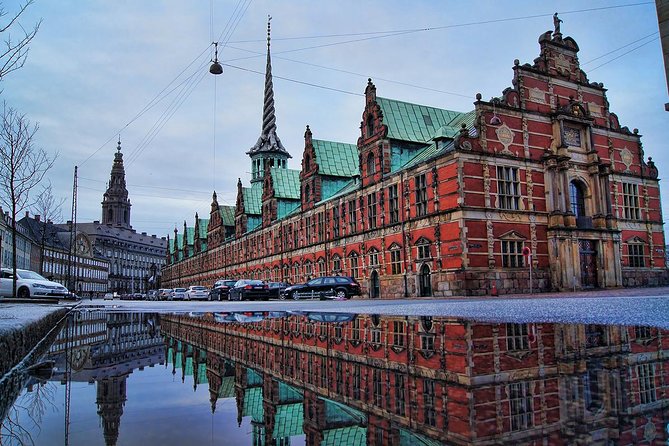
Børsen, the old Stock Exchange, dates from the 1620s and was built under King Christian IV. It operated as a stock exchange into the 1800s, with its upper floors once used to trade physical goods. Today, Dansk Erhverv owns the building.
Look for the distinctive dragon-tail spire. The intertwined tails are one of Copenhagen’s most memorable rooflines, and they make Børsen easy to identify from the water or nearby streets.
Christianshavn offers a change of mood. The tour stops to overlook its canal and Our Saviour’s Church. The canal district gives you a glimpse of Copenhagen’s waterside neighborhoods, while the church is known for its prominent exterior form. The tour description promises a view, not a climb or interior visit.
The route also includes an 18th-century mansion with collections about Denmark’s people, culture, and past, as well as the National Gallery, which holds international collections, temporary exhibitions, and activities for children. These are valuable pointers if you are planning a second day, but the short tour cannot give them the attention they deserve.
The Black Diamond provides a strong modern contrast. Built in 1999, it is the extension of the Royal Danish Library, faced with black granite from Zimbabwe. A bridge joins it to the older main library building from 1906. Inside are a reading room, music room, café, and bookshop.
You may appreciate this stop even if you are not a library fan. Copenhagen’s older brick and stone buildings often sit close to crisp modern design, and the Black Diamond makes that contrast easy to see.
Langebro and Nyhavn’s colorful finish
Langebro is a lifting bridge that opens for large ships. The current bridge was built in 1954 and designed by Kaj Gottlob. It is 7 meters high and 35 meters long, and Copenhagen City Council owns it.
The bridge also has a practical engineering story. An earlier Langebro was a wooden bridge built in 1690 under King Christian V. Concrete damage caused by rainwater led to repair work beginning in 2019, with a projected cost of 307 million kroner, about 40 million euros.
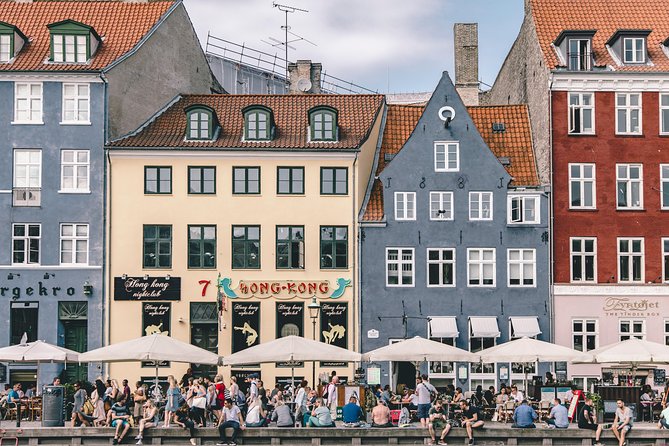
Nyhavn is the tour’s natural finale. Built between 1671 and 1673 by Swedish prisoners of war, it began as a working harbor rather than the restaurant-lined promenade you see today. Nyhavn 9 is the oldest house, dating from 1681.
Hans Christian Andersen lived at several Nyhavn addresses, including numbers 18, 20, and 67. The memorial anchor at the harbor end was placed in 1951 for Danish merchant seamen who died during the Second World War.
The canal is photogenic, but it is also crowded with restaurants and pavement cafés. The area was rougher in the 1970s and was renovated in the 1980s. You may want to return later for a meal, but lunch is not included in the tour, and the schedule does not promise dining time.
What $61.40 buys you
At $61.40 per person, this tour offers solid value if you are short on time. You are paying for a guide or host-driver, an air-conditioned vehicle, onboard Wi-Fi, an audio guide, and a route that connects distant parts of Copenhagen. Entry tickets and lunch are not included, but most named outdoor stops have no admission charge.
The value is strongest for cruise passengers. Past bookings have used the outing to fill a few hours before sailing, with hotel pickup and transportation toward the cruise terminal. One booking included a drop-off at the cruise terminal with enough time before departure.
Confirm the exact pickup and drop-off arrangement before you book. The official meeting point is Banegårdspladsen 2, and the listed end is back at the meeting point, while pickup is offered and flexible cruise arrangements have been described. Those details may depend on your booking.
The group limit is 33 people. That is not intimate, and photo stops can take longer when everyone needs to exit and reboard, but it keeps the price below a private tour. The air conditioning, Wi-Fi, and audio guide are useful extras, especially when the guide is speaking while you are seated away from the front.
Guide quality and the right kind of guest
The strongest praise centers on the guides. Christian and Peter are specifically named in the feedback, and Crispin and Peter are also mentioned in a provider response. The consistent point is clear: the guide’s energy and command of Copenhagen’s story can make this fast route feel relaxed instead of frantic.
Several comments praise the pace, saying there was enough time to learn and appreciate the city. Others describe it as a strong choice before a cruise because the guide and driver worked hard to show as much as possible in limited hours.
I would choose this tour if you are visiting Copenhagen for the first time, arriving before a cruise, staying only briefly, or traveling with someone who does not want a long walking route. It also suits you if you prefer hearing context while moving between landmarks.
I would not choose it as your only Copenhagen experience if you want palace interiors, museum galleries, long canal walks, or unhurried café time. The route is broad by design. You see many places, but you will need to return to the sights that catch your interest.
Most people can participate, and the tour runs near public transportation. It can take up to three hours rather than exactly two and a half, so do not schedule a tight appointment immediately afterward. Free cancellation is available until 24 hours before the start time. A minimum number of bookings is required, and if the operator cancels for that reason, you are offered another date or a full refund.
Should you book this Copenhagen tour?
Book it if you want maximum coverage with minimum planning, especially on a cruise day. The noon guard change, Little Mermaid, Christiansborg, Christianshavn, Børsen, and Nyhavn give you a useful first map of Copenhagen, while the guide adds the names and stories you might otherwise miss.
Skip it if your priority is slow sightseeing. In that case, spend your money on a museum or palace admission and explore one district on foot. For everyone else, $61.40 is a reasonable price for a guided city sampler that handles the distances and leaves you with a clear list of places to revisit.
FAQ
How long does the Grand Tour of Copenhagen last?
The tour lasts approximately two hours and 30 minutes, though additional information says it can take up to three hours.
What time does the tour begin?
The listed start time is 9:30 am.
Where does the tour start?
The meeting point is Banegårdspladsen 2, 1570 København, Denmark.
Where does the tour end?
The listed end point is back at the meeting point.
Is pickup available?
Yes. Pickup is offered, and the experience has been used for hotel pickup and cruise-port transportation arrangements. Confirm the exact details for your booking.
Is lunch included?
No. Lunch is not included in the tour price.
What is included in the price?
The tour includes an air-conditioned vehicle, Wi-Fi onboard, an audio guide, and a host or driver.
How many people can join the tour?
The maximum group size is 33 people.
Just added in Copenhagen
- WWII Copenhagen Nyhavn and War Museum Private Walking Tour★ 5.0 · 2 reviews
- a day at North Zealand Castle Tour★ 4.5 · 19 reviews
- World-class street football experience in Copenhagen★ 5.0 · 1 review
- Copenhagen Walking Tour with Food Testing (smorrebrod dish & snap)★ 4.5 · 10 reviews
- walking tour – Copenhagen and Christiansborg 3 hours★ 4.0 · 7 reviews
- Stevns Klint UNESCO World Heritage Site Tour from Copenhagen★ 5.0 · 1 review
- The Philosopher’s Last Walk: An audio tour on the life of Søren Kierkegaard★ 4.5 · 5 reviews
- The Six Forgotten Giants Trolls Hunt with Minibus★ 4.5 · 27 reviews
Danish Castles and Palaces, compared.
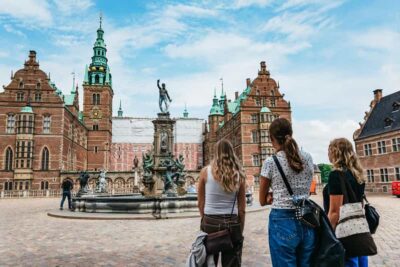
Kronborg, Frederiksborg Castle and Roskilde Tour
Read our review →
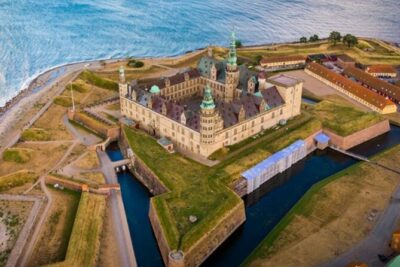
Full-Day; Castle, Palace, Cathedral & Viking ships Tour
Read our review →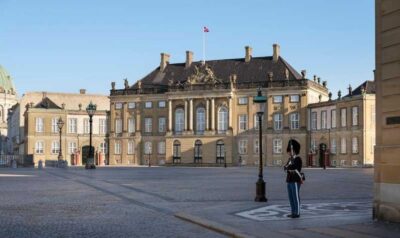
Kronborg (Hamlet Castle) & Frederiksborg Castles: PRIVATE TOUR
Read our review →Browse the lists this tour appears in