Reviewed · GUIDED
Copenhagen: Guided Architecture and Sustainability Tour
Copenhagen rewards curious cyclists. This three-hour ride shows how bold buildings, old industrial districts, and climate-minded planning shape daily life, far beyond the usual sightseeing circuit. I especially like the 17-kilometre route and the way it connects design with ordinary city life. I also like that local guides such as René, Jörn, John, and Josephine add personal stories instead of simply reciting building facts. The main caution is that 17 kilometres can feel demanding if you rarely cycle, and one account pointed to weak group management when riders became separated.
The $70 price is fair if you want context, not just photographs. You cover a lot of ground, use a properly sized city bike, and reach districts you might skip on foot. This is mainly a tour of modern architecture and urban planning, so you should not book it expecting a detailed survey of Copenhagen’s older buildings.
In This Review
- Key things to know before you ride
- Why a bicycle is the right way to see Copenhagen’s design
- Starting near Blox and crossing Lille Langebro
- Islands Brygge and Copenhagen’s public harbour
- Ørestad, Karen Blixens Plads, and Tietgen Residence Hall
- Amager Fælled and the debate around new development
- Gemini Residence and the Cykelslangen cycle bridge
- Kaktus Towers and the city’s newer housing ideas
- Kødbyen, Enghave Plads, and Israels Plads
- Guides, cycling pace, and group management
- Bikes, rain, children, and extra costs
- Is $70 a fair price for three hours?
- Who should book this Copenhagen bike tour?
- Should you book it?
- FAQ
- How long is the Copenhagen architecture and sustainability bike tour?
- How far will I cycle?
- What language is the tour offered in?
- What is included in the price?
- Are different bike sizes available?
- Are children’s bikes available?
- Do I need to bring rain gear?
- Are baskets and phone holders included?
- Can I cancel the booking?
Key things to know before you ride
- You cycle about 17 kilometres: The route is active but spread across three hours, with frequent stops for explanations and photographs.
- The focus is modern Copenhagen: Expect urban design, housing, harbour redevelopment, sustainability, and 21st-century architecture.
- You leave the classic centre: Blox, Islands Brygge, Ørestad, Amager Fælled, Kødbyen, Enghave Plads, and Israels Plads show a less familiar side of the city.
- The guides shape the experience: René is praised for safety and warmth, Jörn for thoughtful explanations, and Josephine for clear teaching with humour.
- Bike equipment is practical: Helmets, several adult frame sizes, rain ponchos, luggage storage, and a lounge with toilets are included.
- Extras cost more: Baskets and phone holders cost 49 DKK each, while e-bikes, tandems, cargo bikes, and child seats require an additional fee.
Why a bicycle is the right way to see Copenhagen’s design
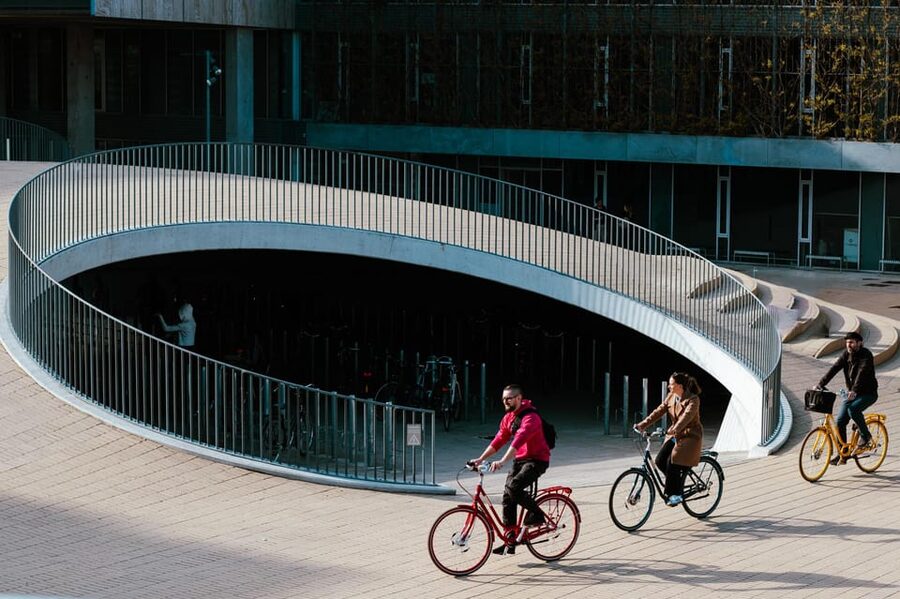
Copenhagen is built for cycling, and that matters here. You are not looking at buildings from a tour bus window or walking between isolated points. You are moving through the connections between neighbourhoods, bridges, harbour edges, housing projects, public squares, and former industrial sites.
That movement helps explain the city’s priorities. A new building matters, but so does the path leading to it. A harbour pool matters, but so does the decision to make the water accessible for public use. A student residence matters, but so does the way its form creates shared outdoor space.
The route also lets you see the city’s contrast between old and new. Copenhagen does not erase its industrial past. Instead, former working areas are reused for housing, food, culture, recreation, and public gathering. This makes the tour more useful than a simple list of striking façades.
You should expect regular stops rather than three hours of nonstop pedalling. Most stops last about five to ten minutes. The ride includes quiet stretches, scenic passages, and longer explanations at key buildings.
A few more options to weigh up in Copenhagen
- Copenhagen: Canal Cruise with Guide
★ 4.6 · 9,115 reviews - Copenhagen: Highlights 3 Hour Bike Tour with a Local Guide
★ 4.8 · 2,312 reviews - Copenhagen Sightseeing Classic Canal Tour With Live Guide
★ 4.5 · 1,906 reviews
Starting near Blox and crossing Lille Langebro
The ride begins from the Tropical Bikes area on Vester Voldgade, though the exact meeting point can vary with the option you book. The shop provides bikes in adult frame sizes of 48, 51, and 56 centimetres. If you need a children’s bicycle, 24-inch and 26-inch options are available, but you need to reserve them ahead of time.
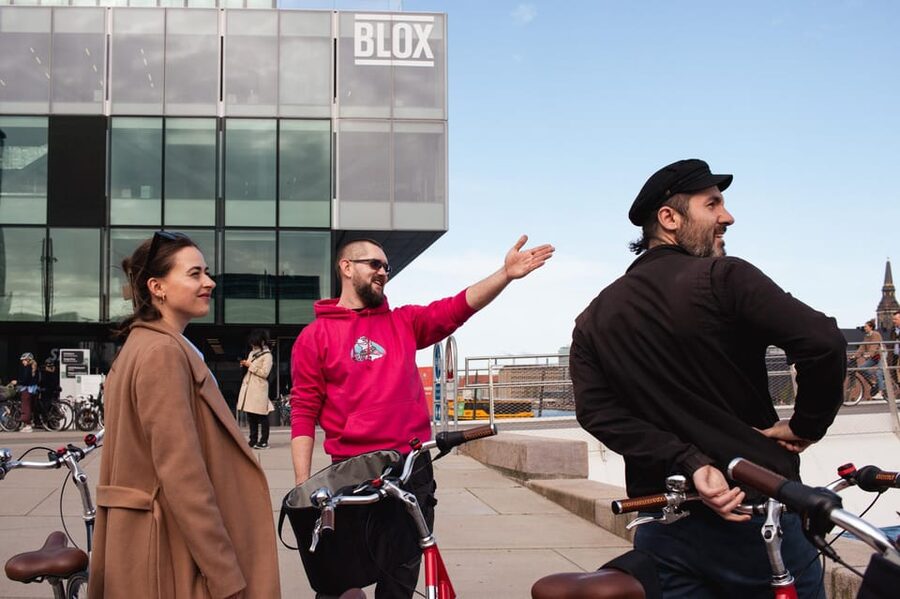
The first major stop is Blox, a striking cultural and urban development by the harbour. It is a good opening lesson because it introduces the tour’s main question: how can a contemporary building bring people together while responding to its waterfront setting?
Your guide should help you look beyond the exterior. Pay attention to the building’s relationship with paths, public space, and the water. The stop is listed at about ten minutes, enough for an introduction without turning the tour into a long architectural lecture.
Next comes Lille Langebro, a modern cycling and pedestrian bridge. The stop is short, around five minutes, but its importance is practical. You see how Copenhagen gives bicycles and walking routes a direct role in city planning instead of treating them as afterthoughts.
This is also one of the places where riding gives you a clearer sense of scale. You cross as a cyclist, not as a distant observer. The bridge becomes part of the city’s daily transport system, not merely a piece of engineering to photograph.
Islands Brygge and Copenhagen’s public harbour
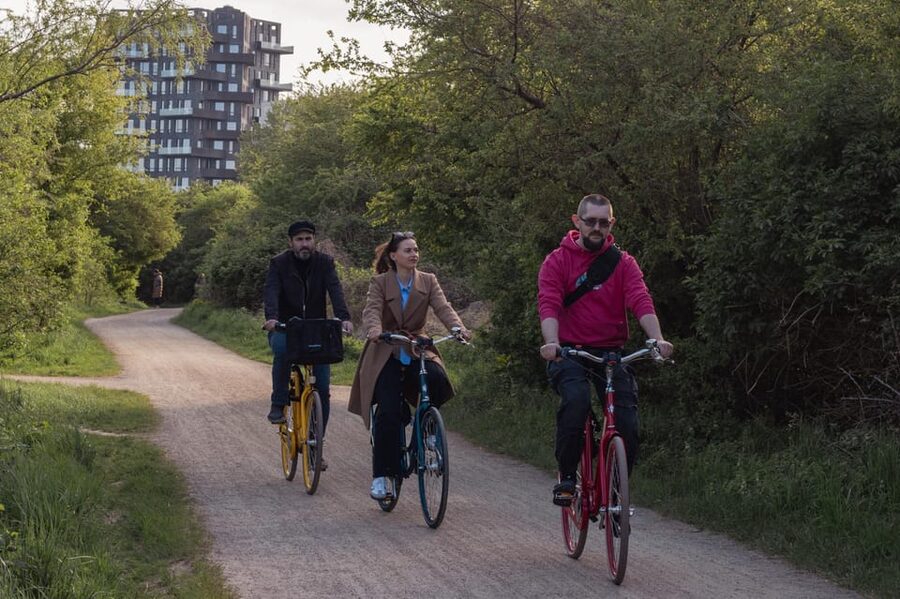
At Havnebadet Islands Brygge, the tour turns to the harbour as public space. The harbour was not always the inviting recreational centre you see today. Its transformation shows how waterfront planning can change the way residents use a city.
The stop lasts roughly ten minutes. Your guide may connect the swimming area with larger choices about water quality, access, recreation, and public ownership. The point is not simply that people swim here. It is that an area once associated with industry has become a place for everyday leisure.
This part of the route gives the sustainability theme a human scale. You are not only discussing emissions targets or energy systems. You are seeing how planning decisions affect where people meet, exercise, and spend time outdoors.
The harbour section is also among the calmer parts of the ride. One account described the cycling as peaceful, especially on a sunny holiday. Weather will affect the mood, of course, but the route is designed to let you experience Copenhagen at street level.
Ørestad, Karen Blixens Plads, and Tietgen Residence Hall
Karen Blixens Plads introduces another side of Copenhagen’s newer planning. The area is connected with Ørestad, a district known for large-scale contemporary development and unusual building forms. Here, you can consider the challenge of creating a coherent neighbourhood from relatively new construction.
The ride through Ørestad includes a scenic section of about five minutes. You will likely have time to notice the broad spaces and bold buildings before stopping again. This is a useful contrast with the tighter streets and older blocks near the centre.
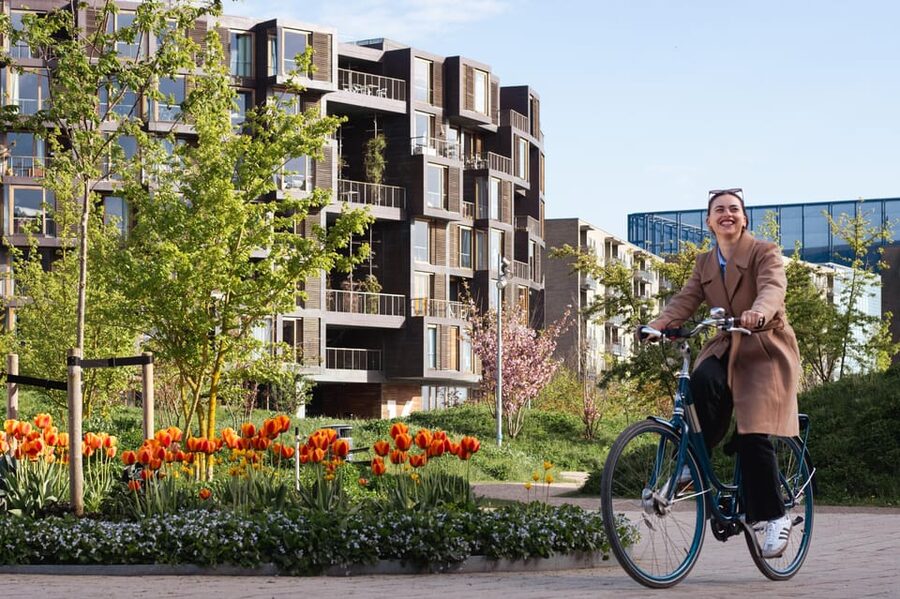
The Tietgen Residence Hall is one of the most memorable architectural stops. Its circular form creates a strong visual impression, but the more important question is how student housing works inside it. The guide can explain how the shape supports shared life while still giving residents private rooms.
This is exactly where the tour’s humanistic angle earns its keep. You are encouraged to ask what a building feels like to live in, not just why it looks unusual. For architecture fans, Tietgen Residence Hall is likely to be a highlight. For everyone else, it offers a practical example of how design can influence community.
A completely different kind of day out:
- Copenhagen: Hop-On Hop-Off Bus Tour with Boat Tour Option
★ 3.9 · 4,122 reviews - Private Walking Grand Tour of Copenhagen
★ 5.0 · 3,953 reviews - From Copenhagen: Lund and Malmö 2-Country Tour
★ 4.7 · 2,772 reviews - Copenhagen Highlights Walking Tour
★ 5.0 · 2,324 reviews
Amager Fælled and the debate around new development
The route then reaches Amager Fælled, an open natural area near the newer parts of the city. This stop adds a needed counterpoint to the buildings and bridges.
A sustainability tour should not suggest that every new project is automatically good for the environment. Development always creates choices and disagreements, especially when housing needs meet the desire to protect open land. The guide’s role here is valuable because the city’s progress has involved difficult decisions, not just easy successes.
One particularly strong part of this experience is its willingness to discuss how Copenhagen has struggled with the choices that shaped its current identity. John was praised for presenting that process with passion, and this kind of explanation can make the tour feel more honest than a standard promotional city tour.
You may appreciate this stop most if you want to understand planning as a work in progress. Copenhagen is often held up as a model, but its approach has developed through debate, compromise, and changing priorities.
Gemini Residence and the Cykelslangen cycle bridge
The E/F Gemini Residence gives you another look at adaptive reuse. The building is associated with former industrial structures transformed into housing, making it a useful example of how Copenhagen reworks its past rather than replacing everything with something new.
Look for the tension between the original function and the new residential use. That contrast is central to the city’s architectural character. Industrial volumes can gain a second life, but the result still carries traces of what came before.
The Cykelslangen follows as a scenic cycling section. Its name refers to the snake-like form of the elevated cycle route. This is a short riding passage, about five minutes, but it may be one of the most enjoyable pieces of the route because you experience cycling infrastructure directly.
The bridge also makes a simple planning point: a cycling route can be useful and visually memorable at the same time. You are not being asked to admire a bicycle path from the side. You are riding through it.
Kaktus Towers and the city’s newer housing ideas
Kaktus Towers is another stop for contemporary design. The buildings are known for their distinctive stacked forms, which give the route another strong visual marker after Tietgen Residence Hall and Gemini Residence.
The important discussion here is likely to be housing. Modern architecture can look impressive in photographs, but a worthwhile guide should also ask who the buildings serve, how they connect with the public realm, and what daily life might feel like inside them.
This is where the tour is strongest for people interested in 21st-century architecture. One lower-rated account found the tour very good for modern buildings and urban design but less useful for earlier architecture. That is a fair warning. The experience has a clear subject, and it sticks to it.
You should also expect the guide to explain more than you could easily gather from an online photograph. Jörn was singled out for sharing material beyond basic internet facts, while René was praised for adding personal touches and making sure riders felt comfortable.
Kødbyen, Enghave Plads, and Israels Plads
Enghave Plads brings the ride back toward a more established part of the city. This public square helps show how Copenhagen combines transport, recreation, greenery, and social space in dense neighbourhoods.
The stop takes about ten minutes. Rather than treating the square as an isolated design object, your guide can place it within the surrounding district. This is one reason the bicycle format works well: you see the square as part of a connected neighbourhood.
The route also passes through Kødbyen, the former meatpacking district. Its industrial buildings and later uses illustrate Copenhagen’s habit of giving old working areas new functions. The result is not a museum district frozen in time, but a place where heritage and new activity share the same streets.
Israels Plads is the final listed stop. The square has been reshaped as a more people-friendly public area, giving the tour a fitting ending. After seeing large buildings, harbour projects, and cycling infrastructure, you finish by considering the everyday square.
This final portion helps tie the route together. Sustainability is not only about spectacular new construction. It also concerns how an existing city can make room for play, public life, walking, cycling, and community use.
Guides, cycling pace, and group management
The guides receive especially strong praise for being friendly, clear, and careful. René is noted for making riders feel safe and comfortable. Jörn brings extra detail and enthusiasm, while Josephine combines solid architectural knowledge with humour. John’s explanations of Copenhagen’s difficult planning choices add a more reflective tone.
The guide’s personality matters because the subject can become technical. A good explanation turns a building into a story about housing, transport, water, public space, or climate policy. The guide also needs to keep the group together while talking and riding.
That last point deserves attention. One four-star account reported that some riders became separated because group management was not strong enough. I would stay alert at crossings and make sure you know the guide’s signals and regrouping habits. This is a small concern, but it matters more on a 17-kilometre ride than it would on a short walking tour.
The tour runs in English or German, and a private group option is available. A private outing may suit you if your party has mixed cycling speeds or wants more time for questions, though the additional price is not provided here.
Bikes, rain, children, and extra costs
The standard experience includes an adult bike, helmet, rain poncho, luggage storage, and access to a comfortable lounge with toilets before and after the ride. Those details add real value, especially if you arrive with bags or face uncertain Danish weather.
You can buy a basket or phone holder on site for 49 DKK each. I would consider a phone holder useful if you need access to directions before or after the ride, but you should not assume these accessories are included.
Special equipment costs extra:
- E-bike: 249 DKK
- Cargo bike: 449 DKK
- E-cargo bike: 649 DKK
- Child seat: 119 DKK
- Basket or phone holder: 49 DKK each
Children’s bikes are available, but you need to reserve them in advance. The activity is not suitable for anyone who cannot ride a bicycle, and the total distance means you should choose an e-bike or another upgrade only if you know a regular bike will be uncomfortable.
The tour operates in all weather. Wear suitable clothing and comfortable shoes, and do not rely only on the provided poncho. Wind, rain, or cool temperatures can make three hours on a bicycle feel much longer.
Is $70 a fair price for three hours?
At $70 per person, this is not the cheapest way to see Copenhagen. You are paying for a guide, bike, helmet, equipment, and a carefully connected route rather than admission to a single attraction.
I think the price works best for first-time visitors who want an orientation to the city’s newer districts. You cover enough ground to understand how the harbour, Ørestad, former industrial areas, and public squares relate to one another. Reaching all those places independently would require planning, cycling confidence, and time.
The value is lower if you already know Copenhagen well or mainly want royal palaces, medieval streets, and classic landmarks. The tour’s strength is modern architecture, sustainability, and daily urban life. It does not try to cover every period of Danish building design.
The free cancellation option up to 24 hours before departure and the reserve-now, pay-later arrangement also make the booking less rigid. Starting times and the meeting point depend on availability and the option selected, so check those details before you set your day around the ride.
Who should book this Copenhagen bike tour?
I would choose this tour if you:
- Enjoy architecture, public spaces, and city planning
- Want to see Copenhagen beyond the central tourist route
- Can comfortably cycle 17 kilometres
- Prefer a local guide to an audio guide
- Like hearing about decisions, conflicts, and compromises
- Want to understand why Copenhagen is often studied as a cycling and sustainability example
I would look elsewhere if you cannot ride a bike, dislike cycling in uncertain weather, or want a history-heavy tour focused on Copenhagen’s oldest monuments.
Architecture students, urban design fans, and curious first-time visitors should get the most from it. Families can join if children are comfortable with the distance and the necessary bikes or child seats are reserved in advance.
Should you book it?
Book this experience if you want to see how Copenhagen works, not just how it photographs. The best parts are the harbour redevelopment, Tietgen Residence Hall, the former industrial buildings, Cykelslangen, and the chance to hear guides such as René, Jörn, John, or Josephine explain the city in personal terms.
Go in prepared for a long ride, modern architecture, and occasional group-management challenges. If you bring suitable clothing, choose the right bike, and stay attentive to the group, $70 buys a thoughtful three-hour introduction to Copenhagen’s greener, newer side.
FAQ
How long is the Copenhagen architecture and sustainability bike tour?
The tour lasts three hours.
How far will I cycle?
You will cycle roughly 17 kilometres in total.
What language is the tour offered in?
The live tour is offered in English and German.
What is included in the price?
The price includes a local guide, a bike, helmet, rain poncho, luggage storage, and use of a lounge with toilets before and after the tour.
Are different bike sizes available?
Yes. Adult bikes are available with 48, 51, and 56 centimetre frames.
Are children’s bikes available?
Yes. Children’s bikes with 24-inch and 26-inch frames are available, but you must reserve them beforehand.
Do I need to bring rain gear?
The operator provides a rain poncho, and the tour runs in all weather. You should still wear suitable clothing and comfortable shoes.
Are baskets and phone holders included?
No. Baskets and phone holders can be purchased on site for 49 DKK each.
Can I cancel the booking?
You can cancel up to 24 hours before the tour for a full refund. You can also reserve now and pay later.
Just added in Copenhagen
- WWII Copenhagen Nyhavn and War Museum Private Walking Tour★ 5.0 · 2 reviews
- a day at North Zealand Castle Tour★ 4.5 · 19 reviews
- Copenhagen Walking Tour with Food Testing (smorrebrod dish & snap)★ 4.5 · 10 reviews
- World-class street football experience in Copenhagen★ 5.0 · 1 review
- walking tour – Copenhagen and Christiansborg 3 hours★ 4.0 · 7 reviews
- Stevns Klint UNESCO World Heritage Site Tour from Copenhagen★ 5.0 · 1 review
- The Philosopher’s Last Walk: An audio tour on the life of Søren Kierkegaard★ 4.5 · 5 reviews
- The Six Forgotten Giants Trolls Hunt with Minibus★ 4.5 · 27 reviews
Guided, compared.
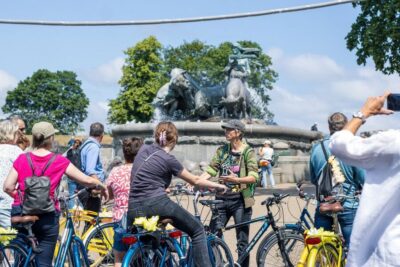
Highlights 3 Hour Bike Tour with a Local Guide
Read our review →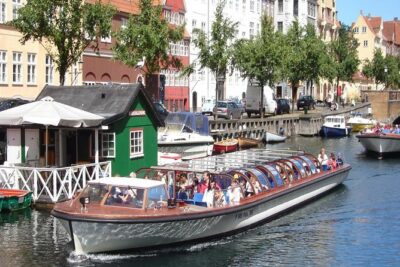
Copenhagen Sightseeing Classic Canal Tour With Live Guide
Read our review →
Copenhagen Highlights 3 Hour Bike Tour with local Guide
Read our review →